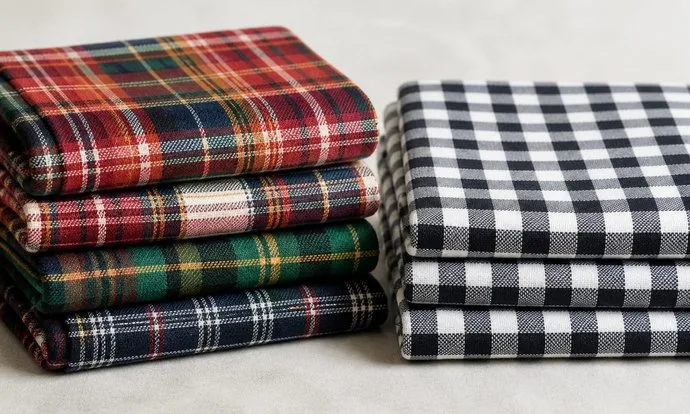
Plaid and check fabric both use intersecting lines, so the terms are often treated as interchangeable. In textile sourcing, however, the distinction is useful. Check fabric usually has a regular, symmetrical grid with repeated squares. Plaid fabric generally uses a more varied arrangement of stripes, colors, and repeat sizes. A tartan fabric is a recognized type of plaid, while gingham and graph patterns are common types of checkered fabric.
The terminology is not perfectly standardized across countries or fashion markets. In North American retail language, “plaid” may describe almost any woven checked shirt. In technical purchasing, designers and suppliers often use “check” for cleaner, more uniform grids and “plaid” for more complex stripe arrangements. The safest approach is to describe the pattern, construction, fiber, and production method together.
This guide explains plaid vs check, how the patterns are made, which one works better for shirts, uniforms, home textiles, and custom programs, and what to ask a check fabric manufacturer before approving bulk production.
Quick answer: plaid is broader and more complex; check is more regular
The simplest practical distinction is pattern structure:
· **Check fabric** normally has evenly spaced warp and weft stripes that create squares of consistent size.
· **Plaid fabric** normally combines stripes of different widths, colors, or spacing, creating a more layered or irregular repeat.
· **Checkered fabric** is a broad retail term for a pattern made from contrasting squares; it may describe a simple check or a more complex plaid.
· **Tartan fabric** is a plaid pattern with a particular heritage and a defined color-and-stripe arrangement. Not every plaid is tartan.
This does not mean that every check has only two colors or that every plaid is asymmetrical. Some patterns sit between the categories, and regional vocabulary can change. For a production order, a visual reference, repeat diagram, color standard, and construction specification are more reliable than the name alone.
Pattern term | Usual visual structure | Common examples | Typical product impression |
Check fabric | Regular grid, repeated squares, balanced spacing | Gingham, graph check, pin check | Clean, orderly, versatile |
Plaid fabric | Intersecting stripes with varied widths or colors | Windowpane plaid, brushed shirt plaid | Casual, expressive, layered |
Checkered fabric | Contrasting squares; broad retail language | Buffalo check, checkerboard | Graphic, bold, recognizable |
Tartan fabric | Structured plaid with heritage sett | Clan tartan, tartan wool | Traditional, distinctive |
What is check fabric?
Check fabric is a textile patterned with crossing vertical and horizontal lines that form a repeated grid. In a simple check, the warp and weft use matching or closely related stripe sequences. Where the colors intersect, the woven structure creates a predictable arrangement of squares.
The pattern may be created by weaving with pre-dyed yarns or by printing onto a prepared fabric. A yarn dyed check fabric has colored yarns in the warp, the weft, or both before weaving. This can create a pattern that is integrated into the cloth and remains visually consistent through normal use. A printed check can offer more artwork freedom and may be more suitable for certain complex designs, but the surface method should be identified in the specification.
Common check patterns
Gingham is a familiar balanced check, often using a white or light ground with one contrasting color. Graph check uses fine, evenly spaced lines that resemble graph paper. Pin check uses very narrow stripes or tiny dots that can look nearly solid from a distance. Buffalo check uses large, high-contrast squares and is often associated with casual shirts, blankets, and rustic home products.
Check scale changes the visual message. Small checks can appear professional and quiet. Medium checks are versatile for shirts and dresses. Large checks feel more casual and graphic, but they can create more cutting and pattern-matching challenges.
What is plaid fabric?
Plaid fabric is built from intersecting stripes, but the stripes do not need to have equal width or equal spacing. A plaid may contain several colors, narrow accent lines, broad bands, blended intersection tones, and a repeat that is larger than a typical check.
Plaid can be woven or printed. In a yarn-dyed plaid, the color sequence is planned in the warp and weft, and the loom must reproduce that sequence accurately. A printed plaid can be placed on a solid base after weaving, which may be appropriate for fashion designs, home décor, or smaller artwork runs.
Plaids often look more dynamic because the eye reads several layers at once. A red, navy, cream, and green plaid with uneven bands feels more decorative than a two-color graph check. That visual richness can be an advantage for seasonal fashion, outerwear, blankets, and lifestyle products, but it can make color control and garment matching more demanding.
Plaid vs check: the key differences
Decision factor | Check fabric | Plaid fabric |
Stripe layout | Usually even and repeated | Often varied in width and spacing |
Typical color count | Often two or three dominant colors | May use several colors and accent lines |
Square size | Usually consistent | May change within the repeat |
Visual character | Structured, neat, controlled | Layered, expressive, fashion-led |
Pattern matching | Usually more straightforward | Requires careful repeat and panel matching |
Typical applications | Uniforms, shirts, workwear | Shirts, jackets, skirts, blankets, décor |
Production priority | Symmetry, spacing, color consistency | Repeat accuracy, stripe sequence, color depth |
The most important production question is not “Which word is correct?” It is “What visual repeat and performance does the buyer need?” A supplier should be able to turn the answer into a construction and color specification.
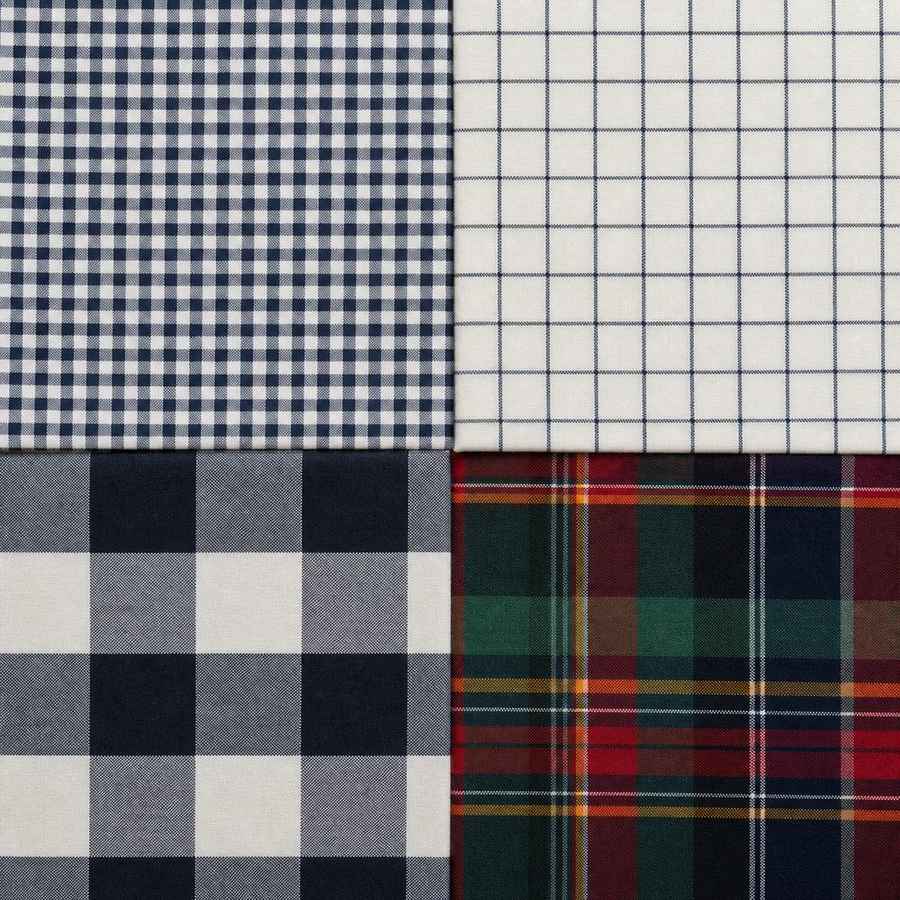
Pattern scale, stripe width, and color count help distinguish a regular check from a more complex plaid.
Woven check fabric versus printed check fabric
Pattern name and production method are separate decisions. A woven check fabric can be made with yarn-dyed warp and weft yarns. The pattern is constructed as the cloth is woven, so both sides may show a related color structure. This method is widely used for shirting, uniforms, cotton check fabric, and durable home textiles.
A printed check is created after the base cloth has been woven or knitted. Printing can reproduce detailed artwork and flexible color placement, but the final appearance depends on print registration, ink or dye penetration, base color, and finishing. The reverse side may not mirror the face in the same way as yarn-dyed fabric.
Yarn dyeing is not automatically better. It can offer an integrated appearance and is useful when the buyer expects a durable, classic woven pattern, but it may require more yarn planning, loom setup, and color approval. Printing can be more efficient for some designs or smaller runs. The correct method depends on the pattern, end use, volume, and target price.
Why yarn dyed check fabric is popular for apparel
In a yarn dyed check, the yarn color is established before weaving. The designer and mill must coordinate the color sequence, repeat size, yarn count, density, and loom settings. When the process is controlled, the check can have a crisp, consistent appearance across the fabric width.
Yarn dyed construction is especially useful for plaid shirt fabric because the pattern must continue across collars, cuffs, front plackets, pockets, and side seams. It is also useful when a buyer wants a fabric whose color structure feels integrated rather than sitting only on the surface.
The trade-off is that a yarn dyed order needs a more detailed development process. A buyer may need to approve yarn colors, a handloom or lab sample, a strike-off, and a bulk standard. The supplier should clarify how the pattern repeat will be controlled and how shade variation will be managed between production lots.
Cotton check fabric, blends, and other fibers
Cotton check fabric is popular because cotton provides a familiar hand, moisture absorbency, and broad compatibility with shirts, dresses, pajamas, children’s garments, and home textiles. Cotton can be woven in plain or twill constructions and may be finished as a smooth shirting, a brushed flannel, or a more structured cloth.
Cotton blends can improve dimensional stability, wrinkle resistance, drying time, or cost control. A cotton-polyester check can be useful for uniforms, commercial apparel, and products that will be washed frequently. Linen checks can suit warm-weather garments and home décor when a crisp, breathable character is wanted. Polyester and other synthetic fibers may support color consistency and easy care, while wool or wool blends can add warmth and heritage character to tartan fabric. The fiber should be stated clearly because “check fabric” describes the pattern, not the composition.
When comparing materials, verify composition, shrinkage, colorfastness, pilling, care, and surface feel. A cotton check fabric may need more shrinkage control; a blend may be easier to maintain but less natural in hand; linen may crease more readily; and wool may require specialized care. These differences belong in the technical brief alongside the pattern name.
The pattern can also change how those material properties are perceived. A dark, compact check may look sharper on a crisp blend, while a large plaid may benefit from the softer drape of cotton or wool. Review the actual fabric in the intended garment silhouette before making a final decision.
Choosing plaid shirt fabric
For a plaid shirt, select the pattern and base construction together. A casual cotton plaid can be plain woven, twill woven, brushed, or unbrushed. A heavier twill can provide more body for an overshirt. A brushed cotton or flannel base can create a warmer hand for fall and winter collections.
The repeat should be compatible with the garment design. Small checks are easier to place on narrow collars and cuffs. Large plaids can create a strong visual statement but require enough fabric to match the design at key seams. The buyer should decide whether matching is required at the front opening, pocket, shoulder, side seam, and sleeve placket.
Color is equally important. A high-contrast check can look sharp but may make mismatched panels obvious. A tonal plaid may be easier to wear and easier to coordinate across a collection. Request a full-width sample or a garment mock-up when the repeat is large.
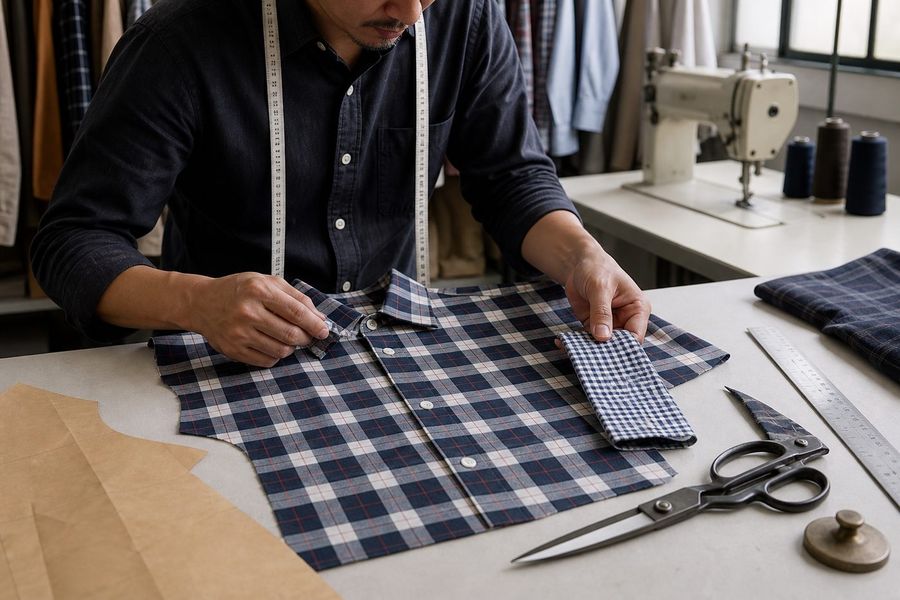
A production sample helps confirm pattern alignment at plackets, pockets, cuffs, and side seams.
When should you choose check fabric?
Choose check fabric when consistency, clean geometry, and scalable production are more important than visual complexity. A small graph check or pin check works well for business shirts, schoolwear, uniforms, and corporate apparel. A medium check can add interest without becoming difficult to style.
Check is also useful when the product line needs a repeatable family of designs. The same base construction can be developed in different colors and scales while keeping a recognizable visual system. Buyers should still confirm that the colors and line widths remain consistent after finishing.
When should you choose plaid fabric?
Choose plaid when the pattern should communicate movement, heritage, warmth, or seasonal fashion. Plaid is often effective for casual shirts, jackets, skirts, dresses, scarves, blankets, upholstery accents, and lifestyle collections.
Plaid is also a natural choice when the design brief includes several color stories or a larger repeat. A tartan fabric can communicate heritage, but the word tartan should be used carefully when a specific registered or culturally recognized sett is intended. If the design is simply a multicolor stripe pattern, “plaid” may be the more accurate commercial description.
How to choose a check fabric manufacturer
A check fabric manufacturer should be evaluated on more than the number of patterns shown in a catalog. The production team needs to understand pattern engineering, yarn planning, weaving, finishing, quality inspection, and repeat-order control.
Ask the supplier for:
1. A clear fiber composition and construction specification.
2. The finished width, GSM, yarn count, density, and weave type.
3. A visual repeat diagram showing stripe order and pattern scale.
4. Confirmation of yarn dyed, printed, or piece-dyed production.
5. Color standards, lab-dip process, and bulk shade tolerance.
6. Shrinkage, colorfastness, pilling, abrasion, and dimensional-stability data where relevant.
7. Pattern-matching guidance for garments and home-textile panels.
8. MOQ, sampling stages, lead time, packing, and reorder procedures.
The JERID TEX TILE check fabric collection shows several cotton, CVC, and TC yarn-dyed check directions. Buyers can compare those options with the broader woven fabric product range when the project may also need flannel, stripe, poplin, or other woven constructions.
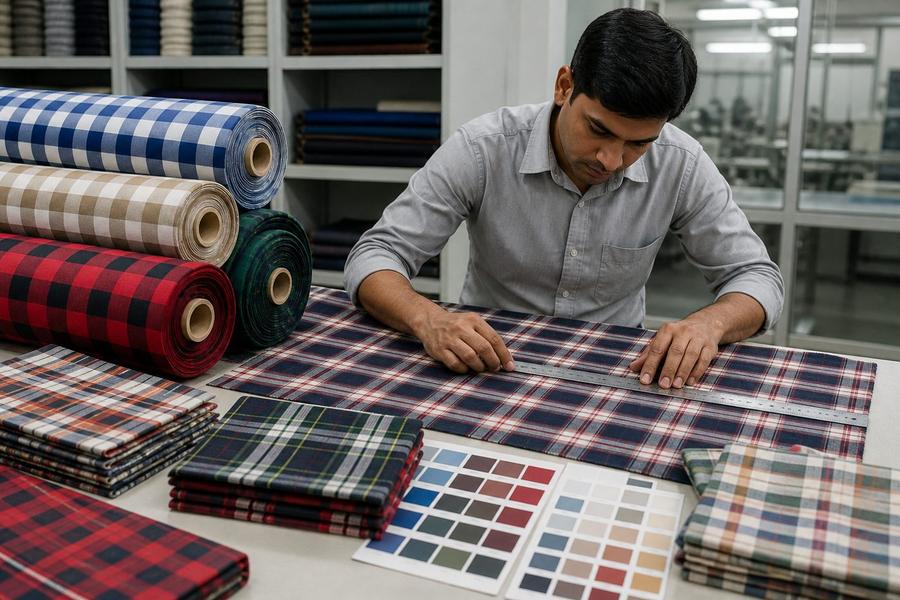
A supplier review should cover pattern repeat, stripe alignment, shade consistency, and finished fabric quality.
Supplier evaluation area | What to request | Why it matters |
Pattern engineering | Repeat diagram, line widths, square size, matching notes | Prevents visual surprises in cutting and sewing |
Color control | Yarn standards, lab dips, strike-offs, shade tolerances | Keeps color consistent across lots |
Construction | Fiber, weave, yarn count, density, finished GSM | Connects pattern to performance |
Finishing | Softening, brushing, washing, heat setting | Affects hand, shrinkage, appearance |
Production control | Inspection points, defect policy, reorder records | Supports reliable bulk and repeat orders |
Custom support | MOQ, sampling, custom colors, widths, patterns | Shows whether supplier fits the project |
Custom check fabric: what the brief should include
Custom check fabric development becomes easier when the buyer supplies a complete visual and technical brief. Include a reference image or artwork, the repeat size, warp and weft stripe order, color codes, preferred fiber, construction, finished weight, width, and target application.
For a yarn dyed check, identify whether the pattern must be symmetrical in warp and weft. For a plaid, show which stripes are dominant and which are accent lines. If the fabric will be used for a plaid shirt, note the required matching points. If it will be used for bedding or curtains, specify whether the repeat must align across wide panels.
JERID’s FAQ section addresses questions about custom fabric services, samples, MOQ, delivery, quotations, and quality inspection. That is a useful next step when a buyer has moved from pattern inspiration to a production request. For a broader view of the company’s integrated production story, review JERID’s About Us page.
Common mistakes in plaid and check sourcing
Using the pattern name as the complete specification
“Plaid” and “check” do not identify fiber, weave, weight, finishing, or production method. Add those details to the purchase specification.
Assuming printed and yarn dyed patterns perform identically
They may have different reverse appearances, color behavior, hand, and production economics. Confirm the method before approving a sample.
Forgetting pattern matching
Large plaids and bold checks can show mismatch at front openings, pockets, side seams, and bedding joins. Build matching requirements into the cutting plan.
Treating tartan as a generic word for any plaid
Tartan often carries heritage and specific stripe-set implications. Use the correct description for the design and market.
Choosing color without considering scale
A color combination that looks balanced in a small swatch may become overwhelming at a large repeat. Review the pattern at actual garment or home-textile scale.
Care and quality checks
Care depends on fiber and finish, not simply on whether a fabric is plaid or checked. Cotton check fabric may require shrinkage control and moderate washing temperatures. Wool or wool-blend tartan may need more careful care. Polyester blends may be easier to maintain but can have different breathability and surface behavior.
Before bulk approval, wash a representative sample using the intended care process. Measure length and width, inspect color change, check the pattern for distortion, and examine the surface for pilling or fuzz. For apparel, make a small sample garment. For home textiles, test the pattern alignment across the finished width.
The check or plaid should remain visually stable after finishing. If the fabric is brushed, napped, or softened, verify that the process does not blur fine lines or change the apparent shade of intersecting colors.
Frequently asked questions
Is plaid the same as check fabric?
Not exactly. Both use intersecting lines, but check usually refers to a regular grid with repeated squares, while plaid usually includes more varied stripe widths, colors, or repeats. In everyday retail language, the terms are often used interchangeably.
Is checkered fabric always woven?
No. A check pattern can be woven, printed, or knitted. If you need woven check fabric, confirm the construction separately from the pattern name.
Is tartan fabric a type of plaid?
Yes. Tartan is generally treated as a type of plaid with a defined stripe arrangement and heritage associations. A multicolor plaid is not automatically a specific tartan.
Is yarn dyed check fabric better than printed check fabric?
Neither is universally better. Yarn dyed construction can provide an integrated pattern and is useful for many apparel programs. Printing can provide design flexibility and may suit different volumes or artworks. Choose based on end use, budget, and test results.
Which is better for a plaid shirt: cotton or a blend?
Cotton is often chosen for its natural hand and comfort. A cotton-polyester blend may offer easier care and improved dimensional stability. The right choice depends on the product positioning, climate, wash routine, and target price.
Final verdict
Plaid vs check is primarily a difference in pattern structure and visual complexity. Check fabric usually offers a more regular grid, consistent squares, and straightforward styling. Plaid fabric usually offers varied stripes, richer color layering, and a stronger seasonal or heritage character.
For uniforms, business shirts, and standardized programs, check fabric is often the practical starting point. For casual shirts, outerwear, blankets, and expressive fashion collections, plaid may be more suitable. The final decision should also account for fiber, weave, yarn dyeing or printing, scale, repeat matching, finishing, and care.